Presenting Data Insights
Structure and deliver clear data analysis
Learn how to distill data analysis down into concise recommendations and deliver takeaways in clear, succinct language that lands with conviction.
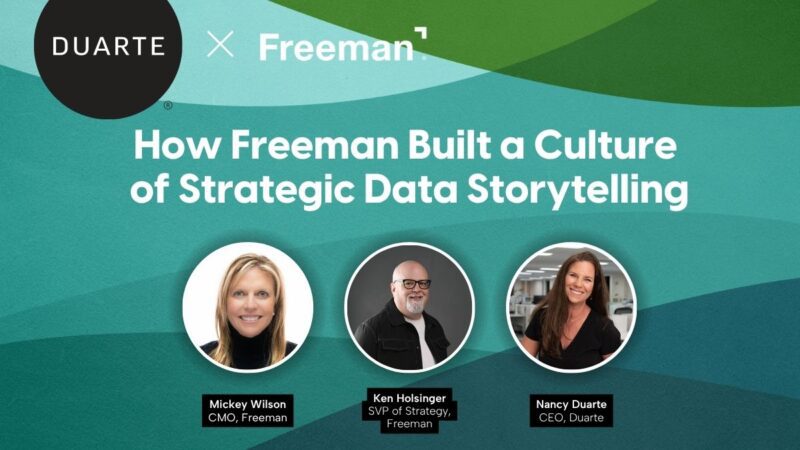
Helping companies make moments that matter at live events is Freeman’s calling. When they’re not elevating brands, Freeman keeps their finger firmly on the pulse of the events industry and conveys their findings with strategic data storytelling. From the halcyon days of pre-pandemic life to the complexities of a post-COVID landscape, Freeman helps companies navigate shifting consumer needs and meet evolving expectations. Beyond keeping their own work razor sharp, Freeman’s quarterly Trends Reports unpack data rich observations to improve the conference and trade show experience for businesses and attendees alike.
But much like hosting the perfect in-person event, strategic data storytelling takes proper planning and execution.
In the tradition of two-heads-are-better-than-one, Freeman found a lasting thought partner in Duarte, who helped put data storytelling on the map. At Duarte, we help companies turn data observations into effective decisions through actionable storytelling. Over the years, Duarte worked closely with Freeman to produce their quarterly Trends Reports and sparked a kindred appreciation for data storytelling that informs the foundation of our shared methodology.
That approach was on full display during our webinar with Freeman’s CMO Mickey Wilson and SVP of Strategy Ken Holsinger. Because Freeman isn’t just known for being in the know. They’ve built a culture where telling stories with data drives strategic alignment that starts from the ground up.
Trust your gut. Listen to your instincts. Follow your nose. Before data took the wheel of strategic decision-making, leaders had to rely on experience and what amounted to vibes when determining the best path forward. But in a world where every facet of a company’s health and operations is trackable, organizations spend less time grasping in the dark. Now it’s about parsing the data and making tactical decisions from measured observations. That’s where data storytelling enters the picture.
When it comes to sharing data with buyers, customers, internally, or in Freeman’s case, event organizers and companies looking to make in-person impact, it’s essential to get the message right. Often, this includes conveying the urgency of acting on an opportunity or navigating a risk identified in the data. For Freeman’s recent Trends Report, harnessing the full potential of your presence at an event was urgent information that cut across business sectors.
Through rigorous data collection, interviews, on-the-ground observations, and careful analysis, Freeman’s quarterly assessments routinely reveal what attendees look forward to when they RSVP. Now more than ever, attendees are looking for real-time expertise delivered through a novel, human-first experience that eschews the hallmarks of a typical sales pitch. For companies selling products, services, subscriptions, or lifestyles, such groundbreaking insights could get lost without the right packaging.
In short, this type of analysis needs a good story to make it come to life. And when it comes to animating data for quick comprehension and action, Freeman’s Ken Holsinger lives and breathes his craft.
As Ken said in the webinar, “If your booth is just a physical version of your website, you’re doing it wrong.”
This principle applies far beyond trade shows. Too many business communications, whether through presentations, emails, blog posts, or social media content, deliver static facts devoid of context or empathy. Free floating figures without a clear, so what? can leave audiences feeling detached or uninvested in connecting the dots to their own experience. This includes rattling off product features or service metrics in lieu of telling a compelling story with the data. It’s all part of the same problem.
Rather, today’s audiences expect relevance and resonance—whether they’re stepping into a booth or reviewing a deck. This is not just Ken’s opinion. This is hard-won data framed as a clear call to action for companies seeking to connect with real consumers. For brands to succeed at events, they must think beyond their browser.
According to Freeman’s 2025 Commercial Trends Report, 84% of attendees want to talk to a subject matter expert. Yet less than half of exhibitors make that a priority. That disconnect isn’t just about logistics—it’s a storytelling problem. When your message doesn’t make your audience feel seen, they disengage. That’s why Freeman takes a multifaceted approach to messaging to ensure their story sticks.
Sharing data effectively means knowing how people will consume it. Some audiences will listen to a presentation where a speaker walks them through the information. Other audiences will read the information on their own, often skimming quickly or returning later for a deeper dive. One of Freeman’s smartest data storytelling practices is building two versions of their reports to make sure it resonates with the intended audience:
From a data storytelling perspective, broadcasting your message across multiple frequencies can ensure you reach your target audience regardless of their preferred method of communication. Going deeper into the effectiveness of this tactic, Nancy Duarte explained how both formats use the same structure to tell a complete story: they lead with empathy, show the stakes, and guide to action.
But what if your organization doesn’t yet have this mindset? Don’t worry. As with any skill, practice, dedication, and continuing education can bring data storytelling within reach for you and your organization. Here’s Freeman’s approach.
As any foreign language learner, fitness fanatic, artist, or creative will tell you: maintaining a skill is just as essential as gaining it in the first place. And when it comes to building a culture of data storytelling, there’s no endpoint. It’s a process that requires ongoing engagement and reengagement to keep skills and practices top of mind.
During the webinar, Mickey Wilson shared how Freeman made storytelling part of their culture: “We take it away from being a subjective conversation to an objective one… and keep educating to build momentum.”
That kind of consistency builds trust—not just with customers, but across internal teams. Freeman’s departments use a shared language to explain what data means, why it matters, and what actions to take next. Once you’ve established a foundation and set an expectation to apply that knowledge base across your organization, data storytelling best practices will take root.
But that’s only the beginning. Thankfully, Duarte is here to help make data storytelling an integral part of your company’s approach to sharing and making decisions from data. Here’s how.
At Duarte, we help organizations like Freeman embed storytelling as a communication standard. Whether through our DataStory® training workshop or high-stakes communication consulting, we equip teams to:
By marrying thoughtful data analysis and classical storytelling, teams, customers, buyers, and sellers can all come together in universal narrative structures to understand the impact of an emerging trend. To awaken your team’s data storytelling potential or upskill your current efforts, Contact us to learn more about our groundbreaking training workshops.
Or for more information about how strategic data storytelling can work in practice, watch the full Freeman webinar here.