Why Leaders Need This Essential Skill

The Duarte Guide to Business Storytelling

Business storytelling is how leaders communicate ideas, data, and strategy in a way that creates belief, alignment, and action. It uses story structure (a clear point of view, the gap between what is and what could be, and a vivid picture of what becomes possible) to make information land, move decisions forward, and turn strategy into something people actually carry out. This guide covers why it matters, how the Duarte Method works, and how it shows up across sales, marketing, HR, executive communication, brand, events, and presentations.

A cluster of circles with business professionals looking forward or in profile are connected by a web of dotted lines. Behind the cloud is the Persuasive Presentation Form which helps structure business storytelling to contrast what is and what could be to guide audiences toward a new bliss. Together, this image demonstrates how effective business storytelling can align a diverse workforce.

Think about the last time you walked out of a meeting knowing exactly what to do next and why it mattered. Not because of a slide or a statistic. Because someone told a story that made the path forward feel clear and worth taking. Then think about the last time you made someone else feel this way. Chances are, it’s been a while.

We have more data, more content, and more ways to communicate than at any point in human history, and yet people still leave meetings confused, deals still stall before they close, and change initiatives lose momentum somewhere between the announcement and the action.

Miscommunication costs U.S. businesses over $2 trillion every year, and the human cost is just as real. According to Grammarly’s 2024 State of Business Communication report, more than half of professionals spend excessive time crafting messages or deciphering what others meant, and over half say poor communication is a direct source of workplace stress. Knowledge workers now spend 88% of their workweek communicating across channels, and the volume keeps going up while the quality is not keeping pace. And despite all that volume, workplace loneliness and disengagement have been steadily on the rise since 2020, with Gallup’s 2024 State of the Global Workplace report finding that only 23% of employees globally are engaged at work.

Image of Duarte CEO, Nancy Duarte, alongside a quote that reads: “If you can communicate an idea well, you have, within you, the power to change the world.” This is a foundational principle of business storytelling.

The real question has never been how much information we’re sharing but whether any of it is actually reaching people and making them feel something. Business storytelling closes that gap between what leaders say and what people actually feel, believe, and do, regardless of the audience, the channel, or the situation.

That’s because stories have resolution, and in business that resolution is: I know what to do next, and I can see what becomes possible if I do. That’s the power of business storytelling, and it’s a skill every leader can learn and the most human and change-resistant capability an organization can build.

Why Enterprise Leaders Need Business Storytelling Skills

BECAUSE THE MARKET WANTS IT, YOUR WORK DEMANDS IT, AND YOUR PEOPLE NEED IT.

A business professional is presenting to four colleagues seated at a conference table. The image is split by a jagged line dividing the room where one side is engaged, and the other is puzzled or distracted by the content. Behind the presenter is the Persuasive Presentation Form that guides business storytelling to toggle between what is and what could be to earn audience attention and drive them to embrace the new bliss of your idea.

If you’re a leader, you’ve more than likely been pulled into projects you shouldn’t need to touch because communication broke down somewhere between the strategy and the people executing it. Nearly half of C-level leaders say they get more involved in projects than they typically should because of ineffective communication, and more than half spend three or more hours a week just providing critical updates. That’s stalled work, frustrated teams, and leadership time that could be spent moving things forward.

Enterprise organizations are recognizing the problem and hiring for the solution. Roles that didn’t exist five years ago, heads of storytelling, Chief Storytelling Officers, dedicated narrative leads, are now sitting at the senior leadership table. Harvard Business Review named social skills the number one capability C-suite recruiters look for. And beyond hiring, organizations are investing in building this capability across their existing leadership teams through leadership development programs that prioritize communication as a core business skill. The organizations acting on both are pulling ahead, and the leaders who understand that communication is an organizational capability are the ones who get hired and stay hired.

Storytelling matters in business because it turns information into belief and alignment: when leaders communicate with clarity and story structure, something tangible changes in how the whole team operates. People understand what they are being asked to do, why it matters, and what success looks like on the other side, which means they make better decisions without waiting to be told, they move faster, and they pull in the same direction. In a business environment where layoffs, restructuring, new strategies, and cultural shifts are happening faster than ever, that shared understanding is what keeps organizations from losing ground between every leadership communication. It’s what keeps people grounded, focused, and willing to follow. That is what persuasive communication looks like when it is built on structure rather than volume.

Think about the difference between these two moments. A sales leader stands up at the quarterly kickoff and says: “We’re shifting our go-to-market strategy to prioritize enterprise accounts and reallocating resources to support a more consultative sales motion.” The room nods. Nobody knows what changes on Monday. Now imagine that same leader who says: “We’ve been losing deals in the last mile because our customers need a strategic partner and our current approach isn’t giving them that. Here’s what we’re going to do differently, here’s what it means for how you spend your time, and here’s what becomes possible for this team when we get it right.” People lean in. They ask questions. They leave knowing exactly what to do next and why it matters. Same information. Completely different experience and results. That’s what story structure does in practice, and it works whether the room has ten people or ten thousand.

Good storytelling also changes how work feels. The data from Grammarly’s report backs this up: 58% of knowledge workers report increased work satisfaction and 48% report reduced stress when communication improves. When people feel heard, when communication is clear and human and connected to something they care about, work becomes more collaborative, more energized, and honestly more enjoyable. That kind of communication builds something lasting: a psychologically safe culture that retains and attracts top talent and drives better business outcomes. Business storytelling helps strengthen and sustain culture and is just as powerful in a one-on-one as it is in an all-teams meeting.

Happy, engaged, and motivated teams also perform better, and building that starts with giving people clarity. On average, half of enterprise employees think their leader’s communication is helpful and relevant, and the ones who feel most informed, most clear on direction, and most connected to the why are consistently the ones who perform best and stay longest. Business storytelling gives leaders a structure that works in every moment, from an email, a one-on-one, an all-teams to a brand brief, so that people always know what’s being asked of them and why it matters. When that clarity is there, productivity increases, retention improves, real human connection happens, and your team starts to operate with the kind of confidence and consistency that doesn’t require you to be in every room. And the employees who stay grow into your next generation of leaders.

The most durable thing you can pass down as a leader is the narrative of how the organization got here, what it believes, and where it’s going. When that story lives in your people, cultural knowledge transfers through leadership transitions, your stakeholders stay aligned, and the values that define your organization travel forward with the people carrying them. And when those next generation leaders already understand how to communicate with clarity and story structure, they walk into their roles ready to keep their teams healthy, motivated, and moving forward without missing a beat. Building this into how you develop your leaders at every level is what turns your leadership into a legacy.

What is Business Storytelling and the Duarte Method™

HINT: IT’S A LOT MORE THAN BUSINESS PRESENTATIONS.

Business storytelling is how organizations communicate ideas, data, and strategy in ways that create belief, alignment, and change. It’s one of the most underutilized tools in the professional toolkit, not because leaders don’t care about communication, they do, but because most are so focused on getting the information out that they forget to think about how an audience will actually receive it. Strategy and data inform. Story moves. And the thing that makes a story work, whether it’s for a keynote or a one-on-one, is that it creates an emotional connection that makes the information land in a way that a spreadsheet never can. When the story you need to tell is built on numbers, that same structure is what turns a chart into a decision, which is the heart of data storytelling.

When you get this right, something shifts. Work gets easier, decisions move faster, and people leave conversations knowing exactly what to do next. Our work with a Big 5 Tech company helped them go from needing 4 meetings on average to get to a decision, down to only needing 1 meeting. That’s what business storytelling does at the organizational level, and it’s what separates the leaders who consistently drive outcomes from the ones who keep scheduling follow-up meetings.

The Duarte Method™ and Business Storytelling

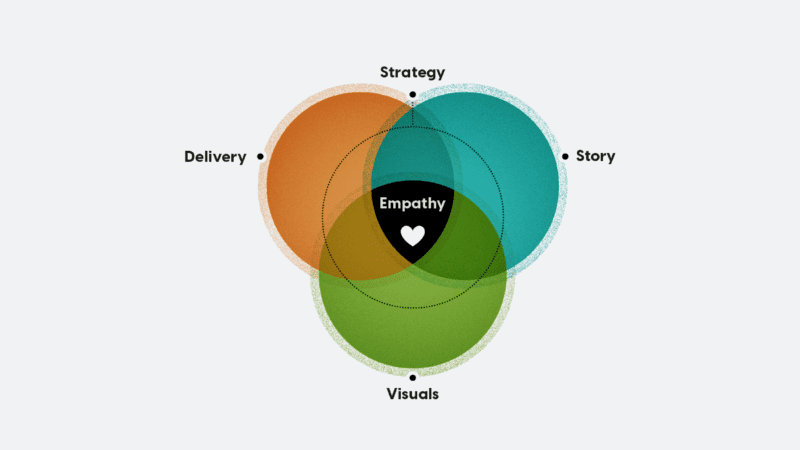
A Venn Diagram with three interlocking circles labeled "Delivery," "Visuals," and "Story," respectfully. There's another dotted circle on the inner portion of the three circles labeled "Strategy", and the center of the image features a heart with the word "Empathy." This illustrates how Delivery, Visuals, and Story, when rooted in Strategy and Empathy, can meet audience needs and elevate business storytelling at your organization.

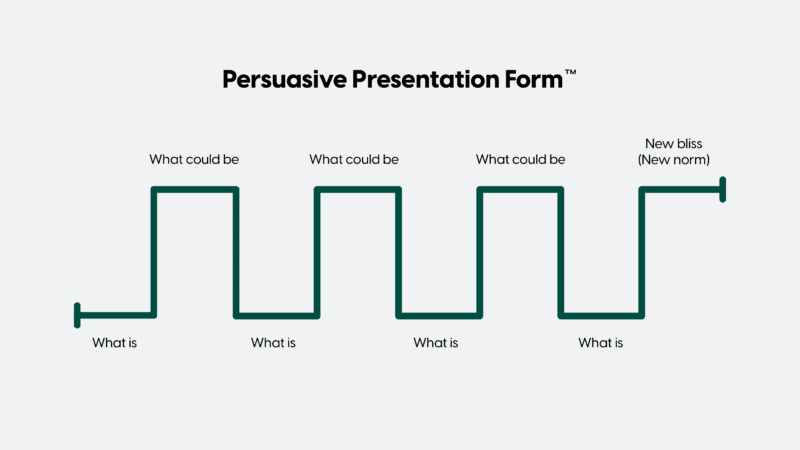
The Duarte Method™ gives business storytelling a structure that is repeatable, scalable, and built from over 35 years of doing the work alongside some of the world’s most recognized organizations. It’s built from what actually works in real rooms with real stakes. After studying hundreds of high-stakes communication moments, from product launches to political speeches to TED talks, the most influential ones all follow the same structure. The Duarte Sparkline is the shape of that structure: it moves an audience back and forth between what is and what could be, and it is the pattern that drives belief and action in every form of business communication we teach. That is the Presentation Sparkline™, and you can see it once you know to look for it.

Every business story starts with one thing: a Duarte Big Idea™. Not a topic, not an agenda, not a list of things to cover. One clear idea, stated as a point of view plus the stakes of taking or failing to take action. If you can’t say it in a sentence, you don’t have a story yet. You have a meeting.

A business story has three parts, and from the Big Idea the journey moves through all of them: a beginning that establishes what is, a middle that opens the gap between what is and what could be, and an end that lands on the new bliss the audience reaches by acting. It starts with common ground, something you and your audience both know and believe to be true. Then it moves to the gap: the difference between where things are right now and where they could be. That contrast is what creates the pull. People move toward ideas that make them feel something about the distance between what is and what could be.

The journey ends with a clear and vivid picture of what they get to experience when they act on your idea. That’s what turns a call to action into a reason to believe.

The Persuasive Presentation Form is a line of peaks and valleys that alternate between describing what is and what could be before arriving at the new bliss or new norm. This structure underpins everything from Dr. Martin Luther King Jr.'s “I Have a Dream” speech to Steve Jobs's iPhone launch. It continues to be a trusted structure for successful business storytelling.

The other shift the Duarte Method™ asks for is putting the audience at the center. Most communication starts with me-ness, leading with company history, product features, or strategy rationale before the audience has any reason to care. Business storytelling flips this. The leader isn’t the hero. The audience is. Your job is to understand where they are, what they’re trying to do, and what they need to believe in order to move. The story is always about what becomes possible for them because you’re proposing it. Before your next high-stakes moment, the Audience Needs Map walks you through who they are and what they need to believe to move.

Please accept statistics, marketing cookies to watch this video.

When you truly internalize this, something changes. You stop sending emails that go nowhere. You stop walking into meetings unprepared. You start asking before every communication: what do I want them to feel, what do I want them to do, and have I given them a reason to do it. That’s when business storytelling becomes how you think.

If you want the full method behind this, the Resonate ebook is the free read that lays out the story structure in depth, chapter by chapter.

Presentations are Where Business Storytelling is Tested Most

You structure a business presentation as a story by opening on the audience’s current reality, moving between what is and what could be to build tension, and ending on the new bliss they reach by acting, which is exactly how storytelling in business presentations turns a deck into a decision. Presentations are the most visible place business storytelling shows up, which is also why they are where it gets tested the hardest. The stakes are high, the audience is real, and there are usually far too many people involved, from strategy to content to creative, from product leaders to visionary executives to communication teams, working on different parts over a long period of time to bring one moment to life. A sales pitch. A leadership update. An all-hands that needs to do more than inform. A big stage moment where thousands of customers, partners, and investors are watching and the story has to land. This is where most leaders realize they need a real approach, a unified story that can’t get lost from meeting to meeting or person to person, not just better slides.

Business storytelling is a framework built for every scenario a leader walks into, and Storytelling for Business Presentations is where most leaders start. The course helps enterprise leaders construct any presentation from the audience out, using the same structure that runs through every form of business communication we teach. Leaders who go through it give better presentations and start thinking differently about every room they walk into. For the tactical version, these storytelling tips for business presentations break the approach into moves you can use in your next deck.

AI is a Tool. Business Storytelling is the Strategy.

We know what you’re wondering: can AI do my business storytelling for me? Short answer, no. It can draft your deck, sharpen your copy, and generate a summary of your last all-teams meeting. Use it. But AI is a powerful tool, and it works best in the hands of someone who already knows what they want to say and who they’re saying it to. It’s also not there when you go off script in the sales call, when a stakeholder pushes back in the room and you need to pivot in real time, or when a one-on-one conversation takes a turn you didn’t plan for. The moments that actually move people rarely happen on a scheduled agenda.

And even when you do use AI to create content, if you don’t understand story structure you won’t be able to judge whether what it gave you will actually land or make your audience feel something. Most professionals are already using AI at work, and most are also concerned about quality control, accuracy, and whether what it produces actually represents their thinking. The ones who get the most from it are the ones who come in with a clear point of view and can tell when what comes back is worth sharing. The tools are the tools. The strategy is yours.

How Business Storytelling Works Across Teams and Functions

Business storytelling shows up differently across an organization, but the structure stays the same. In sales, it gives reps a story the customer can carry. In HR, it gives change announcements meaning. In executive communication, it builds trust at scale. In brand and marketing, it travels across teams. In events, it gives multi-million dollar moments a north star. When it works, the results show up in the numbers and in the moments that define what an organization is capable of. Here is how it works function by function.

Brand and Marketing Storytelling: Creating Unified Communication, Connection, and Results

Most CMOs already know the power of business storytelling. They know how it inspires teams, proves ROI, drives revenue, transforms industries, connects with customers, and builds the kind of brand loyalty that lasts. The challenge is getting crystal clear on the narrative and then getting everyone else to carry it the same way across markets, channels, and teams. When you need to go to leadership for a new campaign budget or a long-term brand investment, can you build a story that influences the decision in your favor? When the brief goes to the creative team, does it carry enough of the why for everyone to produce work that actually resonates across every marketing channel? When sales picks up the deck, do they have enough of the narrative to make it their own and close the deal? Those are the gaps most CMOs are living with every day.

Our business storytelling structure gives CMOs a way to create a unified purpose that can travel across teams and channels. And when the story is clear before it goes anywhere, every team that touches the brand carries it forward with the same conviction.

See how business storytelling helped Salesforce deliver the same story with the same level of pride, where thousands of people needed to carry it the same way. We can train your marketing teams to carry the story forward, or like with Salesforce, we can do the brand and product storytelling work for you.

Sales Storytelling: When the Customer Sees Themselves in the Story, Deals Close

Enterprise sales is different. Picture a high-stakes pitch with three sales people, seven subject matter experts, ten people with ten different sections in one deck, each making the case for their piece of the product. By the time it gets to the customer, it doesn’t feel like one story and it doesn’t feel like they’re at the center of it. The data is there. The proof points are there. But the thread that connects it all to what the customer actually cares about isn’t. That’s me-ness at scale, and it’s exactly where enterprise deals stall.

And the stakes only get higher once the rep leaves the room. According to Gartner, the average enterprise B2B buying group now includes 5 to 11 stakeholders across as many as five business functions, each arriving with their own independent research and their own priorities. 75% of those buyers say they prefer a rep-free experience, which means most of the deal happens when you’re not in the room. If the rep didn’t land the story clearly enough to travel, the prospect who took the call can’t carry it to the rest of the committee, and the story dies somewhere between the meeting room and the group chat.

That’s why having one unified sales story, where the customer is the hero and their possibilities are at the center, becomes critical for getting deals closed. At the heart of every Duarte storytelling structure is the concept of the Big Idea, one clear point of view on the customer’s world that every rep can build from. When everyone in the room is working from that same idea, the pitch stops feeling like a product presentation and starts feeling like a conversation the customer recognizes themselves in. And when they recognize themselves in it, they trust it. And when they trust it, the story survives the internal process that happens after the meeting ends.

Sales storytelling is how organizations build that capability across their reps. Our training programs can help with everything from sales enablement to presentations, and if you’re doing a lot of pitches or executive briefings, we can do the work for you.

And if you’re focused on an upcoming sales kickoff, we can help with that too. From our guides to having a successful kick off to building the decks for your big moment, we’ve got you covered.

HR Storytelling: From Big Announcements to Everyday Beliefs

HR and people leaders are navigating one of the most complex communication environments in business right now. Change fatigue is real, and when employees have been through layoffs, restructuring, and strategy pivots in close succession, even good news lands with skepticism. Front-line managers are expected to cascade messages they may not fully believe themselves, across hybrid and remote teams where tone gets lost and channels are already overcrowded. And when the story’s missing from any of those moments, the gap between what leadership intends and what employees experience grows wider.

What people need during change is to understand why it’s happening, feel that someone sees what it costs them, and believe there’s something worth moving toward on the other side. That’s what we call the Big S, the overarching narrative that gives change meaning and direction. And it only holds together when the little s moments carry it forward, like the one-on-one that acknowledges what the team is feeling, or the follow-up email that sounds like a human wrote it and recognizes the hard but has a clear path forward. Because in any change effort, what people need to hear is always more important than what you want to say. Duarte’s approach to storytelling for change management gives leaders the structure to do both, and Illuminate™ is where that work happens.

The leaders who navigate change most effectively are the ones who resist the urge to deliver difficult news cleanly and instead lead with honesty and humanity. Leaders shy away from personal storytelling because admitting hardship feels like it undermines credibility. And yet the leaders who share what they have lived through, the hard calls, the pivots, the moments of uncertainty, are consistently the ones whose organizations trust them most. Vulnerability in the right moment is the most credible thing a leader can do during change.

Executive Storytelling: Leading with Influence and Authenticity

Being an executive means operating at a level where the information you receive is already filtered, the demands on your time are relentless, and the gap between what you communicate and how it lands is wider than most people will tell you. Most executives default to data, industry benchmarks, and polished talking points because those feel credible and safe. The leaders who connect most effectively go further. They build genuine human connection, communicate with authenticity, and make their messages memorable in ways that data alone never can. Former Starbucks CEO Howard Schultz did this throughout his tenure by consistently grounding every strategic decision and brand pivot in a personal story about his father, who was injured and unable to work when Schultz was a child. That story made Starbucks’ values and mission comprehensible to anyone in the room, whether it was an investor, an employee, or a customer.

And for the unscripted moments, the unexpected town hall question, the reporter who catches you off guard, the leadership meeting that takes a turn you didn’t plan for, knowing the frameworks of business storytelling becomes even more important. These motivating story plots every leader needs to know can help executives build a mental library of story structures they can reach for in any moment, so they can go off script and still show up authentically and consistently.

When the communication is built around what the audience needs to believe and feel, decisions move faster because people understand the why behind them. Difficult conversations happen earlier and land better because there’s a narrative frame to hold them together. The people around the executive start to communicate back, ask better questions, and bring more of themselves to the work. Trust builds, and with it, so does retention. And when executives model this kind of communication, the rest of the leadership team follows. It sets a standard for how the organization communicates at every level, which is how a single leader’s presence compounds into a culture. Delivery is its own discipline, and executive presence is where that side of the work goes deeper. Executive Narrative for Leaders is built to develop exactly that kind of presence. And for executives who want to work one-on-one to refine their delivery, develop their presence, and build a library of stories they can pull from in any moment, our speaker coaching offers personalized 1:1 sessions with coaches who have worked with leaders at the world’s biggest brands.

Event Storytelling: Make the Moment Matter

Product launches, sales kickoffs, industry conferences, customer summits, Upfronts, all-teams, executive offsites. These are the moments organizations invest millions in and need to get right. And they involve so many people, from the executives setting the strategy to the teams writing the keynotes, producing the show, designing the experience, and promoting it across every channel, that misalignment is almost inevitable when the story isn’t clear from the start. More than half of event planners say misalignment of expectations is their biggest challenge, and it almost always starts with a vague or evolving narrative that nobody pinned down before the planning began.

The best events do two things at once. They unify and inspire internal teams around a shared direction, and they hook, move, and transform the customers and audiences in the room. That takes a north star, one clear story that every keynote, every session, every piece of event marketing, and every follow-up communication ladders up to. When that story exists before the agenda is built, everything else has a reason to exist and a direction to point. Speakers stop delivering their own standalone moments and start contributing to something larger. Attendees, whether in the room or joining remotely, feel the momentum building because there’s actually somewhere the event is going. And the impact doesn’t end when the room empties. The events that drive the most lasting value are the ones where people leave with something to carry back, a belief, a direction, a reason to act, that keeps working long after the day is over. We can help you find that north star and build everything around it through our keynotes and events work.

Everyday Business Storytelling

The big stage gets the attention, but everyday business storytelling is where most of a leader’s influence actually happens. It’s the structure you bring to the Monday standup, the project update nobody wants to sit through, the two lines you drop in a channel, the one-on-one where someone needs to hear that the work matters. Same engine as the keynote, smaller room. You name where things are, you name where they could be, and you give people a reason to move.

The leaders who stand out aren’t the ones with the most polished set-piece speeches. They’re the ones whose people always know what’s going on and why, because storytelling for business is built into how they communicate every day, not saved for the quarterly moment. That’s the quiet compounding effect: when clarity is the default, decisions stop stalling, updates stop getting misread, and you stop being pulled into rooms you shouldn’t need to be in. Everyday storytelling in business isn’t a lesser version of the skill. It’s where the skill pays off most often.

How to Build a Brand Storytelling Framework

A brand storytelling framework is a repeatable narrative structure that keeps a brand’s message consistent across teams and channels by anchoring every execution to one Big Idea, the contrast between what is and what could be, and the customer as the hero. It’s what stops a brand from sounding like five different companies depending on which team last touched the work.

The framework starts with the Big Idea, a single point of view plus the stakes, written down before a campaign, a deck, or a landing page ever gets built. From there the Sparkline gives the story its movement, toggling between the customer’s current reality and the better one your brand makes possible, and the audience-as-hero frame keeps the brand in the guide’s seat instead of the spotlight. Once that structure is set, every team that touches the brand has the same source of truth to build from, which is exactly what turns scattered messaging into corporate storytelling that actually moves the numbers. Build the framework once, and the brief, the deck, and the keynote all start pulling in the same direction.

B2B Brand Storytelling

B2B brand storytelling is the practice of using narrative to build trust across a long, multi-stakeholder buying cycle, where the story has to travel from the one person who took the call to the whole committee that never met you. It’s less about a memorable tagline and more about a through-line that survives contact with procurement, finance, IT, and the executive sponsor, each of whom is weighing risk as much as value.

That’s what makes B2B different. With 5 to 11 stakeholders and most of the research happening rep-free, the brand story is often doing the selling when nobody from your team is in the room. A clear narrative lowers the perceived risk of choosing you, gives your internal champion something they can repeat word for word, and keeps every touchpoint, from the website to the sales deck to the follow-up, saying the same thing. Getting a team to carry that story the same way every time is a capability you build, which is exactly why storytelling training matters for organizations that sell into complex accounts.

How Duarte Helps

Three business professionals are seated at a table in front of a Duarte facilitator. The facilitator is pointing to a board with Post-It notes as the colleagues gesture and engage. One speech bubble features two interlocking circles and a rightward facing arrow denoting Duarte's move from/move to framing, while the other speech bubble contains the Persuasive Presentation Form that frames what is against what could be and guide audiences toward a new norm.

We’ve been the driving force behind transformative communication that captures attention, accelerates revenue, and leaves a lasting imprint on the world’s most prominent Fortune 500 companies. We’ve built, tested, and refined the storytelling structure based on data, real-world usage, and experience. We understand the challenges enterprise leaders and their teams face because we’ve lived them, and we can help you avoid the common pitfalls and problems.

Whether your high-stakes presentations aren’t landing, your data isn’t driving decisions, your strategy isn’t sticking, your sales conversations aren’t converting, or nobody is telling your story the same way, business storytelling is how you fix it. And whether you need us to do the work, train your team to do it, or both, we can help.

Tell us what you’re trying to make happen and we’ll be your partner in getting it done.

Let’s Talk