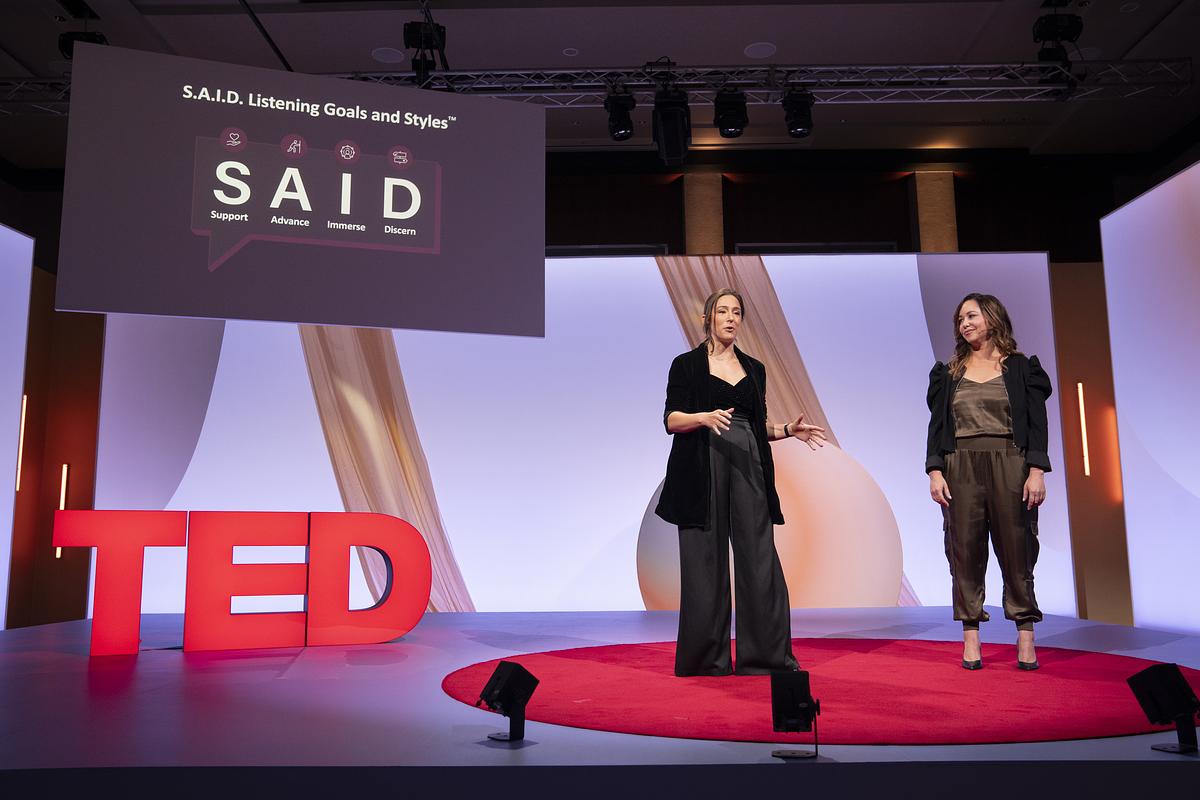
Audience engagement during a presentation, demonstrating Adaptive Listening® in action.

Adaptive Listening®

A New Standard for Listening at Work.

Nicole Lowenbraun and Maegan Stephens spent years researching how the best communicators listen differently. What they found: effective listeners don’t have one mode. They have four.

Find your listening style

Please accept statistics, marketing cookies to watch this video.

There’s more than one way to be a great listener at work.

Most listening advice tells you to pay attention. Use active listening. Nod along.

But fast-paced, cross-functional, do-more-with-less workplaces demand more.

Your customers, colleagues, and leaders need different things in different moments. The real skill is recognizing the goal of the conversation and adapting your response to meet it.

Colleagues enjoying a productive working relationship through better listening

Your CEO doesn’t need you to paraphrase

She needs your honest evaluation. Your direct report doesn’t need you to challenge his idea in this moment. He needs to know you heard him. The client who just lost a deal doesn’t need your action plan. Not yet. She needs two minutes of your support.

The gap between listening well and listening right is where most workplace communication breaks down. Not from bad intentions. From good listening aimed at the wrong goal.

The S.A.I.D. Framework

Every workplace conversation has a goal. Breakdowns happen when the listener misses it.

The S.A.I.D. Framework identifies the four listening goals, reveals the listening style you default to, and shows you how to adapt in real time.

Support listening style icon

Support

Listen to validate and connect.

When the moment calls for empathy, resist the urge to fix. Acknowledge what the person is feeling before moving to solutions.

Advance listening style icon

Advance

Listen to drive action.

When a decision is needed or a conversation is stuck, listen for what will move things forward. Interrupting is sometimes the right call.

Immerse listening style icon

Immerse

Listen to absorb and understand deeply.

When you’re learning something new or navigating complexity, your job is to take it all in. Hold your questions. Remember what matters.

Discern listening style icon

Discern

Listen to evaluate and challenge constructively.

When quality matters or risk is on the table, your job is to catch what others miss. Think critically. Speak up.

In Practice

How Adaptive Listening® Works in Real Conversations

Professional presenting a new business concept to colleagues

Before a Conversation

Read the context. Is this person celebrating a win, stuck on a decision, orienting you to something new, or asking for your critical eye?

During the Conversation

Notice when your default isn’t landing. If you’re driving toward a decision and the other person keeps circling back, they may need you to immerse first.

After the Conversation

Reflect. Did the person get what they needed? If the meeting ended without alignment, the listening style may have been the gap.

This isn’t a personality test. Your listening style isn’t fixed. It’s a skill you can build and adjust, conversation by conversation.

Find Your Style

What’s Your Listening Style?

Most of us have a style we lean on without thinking about it. Knowing yours is the first step toward adapting. The S.A.I.D. Listening Style™ Finder is a short assessment that shows you which style you default to and where you have room to grow.

Take the Listening Style Quiz

Go Deeper

Frequently Asked Questions

What is Adaptive Listening®?

Adaptive Listening® is a workplace communication framework developed by Nicole Lowenbraun and Maegan Stephens. It teaches you to recognize what the other person needs from you in a conversation and adjust your listening approach to match. The framework identifies four listening goals: Support, Advance, Immerse, and Discern.

Is Adaptive Listening® the same as active listening?

No. Active listening focuses on showing attention through behaviors like eye contact and paraphrasing. Adaptive Listening® focuses on matching your response to the goal of the conversation. Sometimes the right response is supportive. Other times it’s a challenge, a decision, or simply absorbing the details without jumping in.

Can anyone learn Adaptive Listening®?

Yes. Adaptive Listening® is a skill, not a personality trait. Most people default to one or two styles naturally. The framework teaches you to recognize when a different style is needed and how to shift.

Where does the S.A.I.D. Framework come from?

The S.A.I.D. Framework was developed through years of research and tested with enterprise teams at Fortune 500 companies. It draws on communication science, organizational behavior research, and thousands of workshop participants. The framework is detailed in the book Adaptive Listening and explored in Nicole and Maegan’s TED Talk.


Get updates on workshops and upcoming dates

Notify me about the next Adaptive Listening® training.