
Adaptive Listening®
Build trust and traction
Uncover a better way to listen that goes beyond active listening and paying attention. Learn about the way you prefer to listen, and adapt to meet the needs of others.


Say your coworker stops by your desk and says, “I’m completely underwater this week.” Effective listening skills are the ability to pick up on what someone’s really saying in any situation and engage in the right way that shows you understand, makes them feel heard and can take on the right action.
And we’re taught as children that being a good listener is really important, but usually that’s limited to basic skills like avoiding speaking, staying silent, nodding your head, making eye contact, and not interrupting. And as a kid, those are good things to do, but as an adult in the workplace, paying attention is the bare minimum, especially if you’re a leader.
The better way to listen is what we call Adaptive Listening™. It’s the ability to accurately hear, engage and respond to all different people and situations, which keeps people connected and moves situations forward. Here are some ways you can learn better listening skills and incorporate them into your workday.
Being an effective listener means listening in a way that meets the goals and needs of the person speaking to you. In most cases, that involves a lot more than nodding your head and making eye contact. It takes critical analysis and observation to figure out what your communication partner needs. But you can build more effective listening skills by implementing Adaptive Listening™ – a better way to listen effectively at work.
Adaptive Listening is for those wanting to improve the way they, and their teams, communicate up, down, across, internally, and externally. The Adaptive Listening model teaches listeners how to process and respond in a way that meets the speaker’s goals during an interaction. Adaptive Listening requires you to ask yourself this fundamental question:
“What does the person speaking need from me?”
This is something most listeners simply don’t do. Instead, we tend to focus on, “What’s in it for me?” or “What’s the speaker going to say that could impact my job?” We rarely, if ever, think about what we can give the speaker when we’re listening.
Adaptive Listeners™ are different. They ask themselves what the speaker needs and then deliver on those goals. By doing so, they can expect better outcomes, too. The benefits of effective listening in the workplace are numerous. Effective listening can:
… just to name a few. How can you achieve the benefits of these effective listening skills? Become an Adaptive Listener! By doing so, you’ll be able to determine one, or a few, of the following goals the speaker needs your help to achieve …
When people talk about types of listening or listening styles, they usually mean the different modes you shift into depending on what a conversation calls for. Adaptive Listening sorts these into four types, built around what the speaker needs from you: listening to Support, Advance, Immerse, and Discern. Your listening style is simply the type you reach for most, whether or not it fits the moment. Those four types make up the our S.A.I.D. model below, and learning to move between them on purpose is what separates effective listeners from people who are only paying attention.
In the workplace, speakers either want you to:
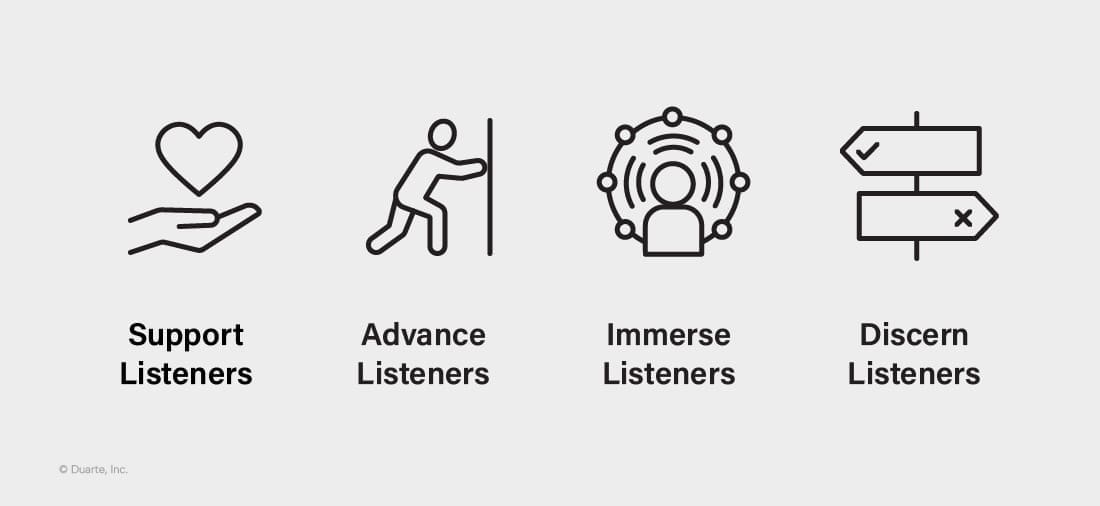
These goals are easy to remember because they form the acronym S.A.I.D.™ After all, effective listening requires you to listen to what the speaker has said (and even what they haven’t said). Let’s break each one down …
Everyone experiences challenging workdays. But we also enjoy moments of celebration at work. While on opposite spectrums, both situations lead to a desire for human connection. We want comfort when things are rough, and we want congratulations and celebration when things are going great. Effective Support Listening skills require you to acknowledge and mirror the speaker’s feelings.
If they say something like, “I’m having a horrible day,” or “I have the best news!” that’s your cue that the person speaking needs your Support Listening skills. In this case, your job is to respond with words and actions that will validate the speaker’s emotions, whether that’s to commiserate with them or celebrate with them. Your job is to either be the confidant or the cheerleader, depending on the context and situation.
When the people we work with are overwhelmed or pressed for time, they’re often looking for someone to unburden them or lighten their load. Being an effective listener in this case means listening in a way that will move people, projects, and processes to the next step.
If the person speaking says something like, “I don’t think I’ll have time to finish all of this,” or “I don’t know how I’m going to keep this project moving,” that’s a sign they need your Advance Listening skills. You might take on some of that work yourself by saying, “I can take some of this off your plate,” or you might choose to delegate tasks to help the speaker get to the finish line.
There are many workplace situations in which the speaker needs you to absorb the material they’re delivering without comment or judgement. When the speaker’s message is meant to inform or simply entertain, being an effective listener means learning the information and soaking it all in.
If the person speaking says something like, “I’m here to give you an update today,” or “Sit back and enjoy!” that’s your cue that they need your Immerse Listening skills. In this case, your job is to take notes or mentally catalogue the information you’re hearing. You might ask clarifying questions or confirm what you’ve heard for the purposes of understanding, but your main goal is to be a content sponge.
We all need judgement and critique at some point in our work world. The workplace requires critical thinking, especially when evaluation is needed on presentations, projects, processes, even people! Without it, costly, even dangerous mistakes, might go unnoticed or unchecked. When the people you work with need you to evaluate information or identify potential risks and rewards, they need your Discern Listening skills.
Being an effective listener in this case means you need to consider the strengths and weaknesses of their situation or project. Your job is to help the speaker find red flags and pinpoint positives. If they say something like, “I need some feedback on this,” or “I’m not sure if this makes sense,” that’s your cue to be a Discern Listener. Respond with words and actions that will help the speaker identify what’s working and what’s not.
Each of these four S.A.I.D. Listening Goals™ (Support, Advance, Immerse, and Discern) puts empathy at the heart of your effective listening skills, because it encourages you to truly understand what the other person needs. This model for effective listening paints a very different picture from that of the listener who simply pays attention.
You might be wondering, “How do I know which of these effective listening strategies is needed when? And with whom?” It can be tricky to determine how and when to adapt your listening skills to meet the needs of the person speaking. Don’t worry, we’ve written a book for that!
Researched and tested exclusively in the work setting, the book Adaptive Listening helps readers up-level their effective listening skills in a way that moves beyond active listening. Whether listening to:
After all, our work lives are dynamic. Speakers need different things at different times, and it’s not always easy to figure out what their goals are. But if you start by asking yourself, “What does the person speaking need from me?” you’ll be well on your way to dramatically improving your listening skills.
In our Active Listening training, teams strengthen two capabilities that turn listening into a skill they can use on purpose:
Our methodology was built over three and a half years of research and tested inside real organizations before it was published. It’s reached the TED stage and won a 2026 Cicero Speechwriting Award.
Talk with our team so we can understand your needs, the conversations that matter most, and where better listening would change the outcome.