
Adaptive Listening®
Build trust and traction
Uncover a better way to listen that goes beyond active listening and paying attention. Learn about the way you prefer to listen, and adapt to meet the needs of others.


Some habits can be hard to break. And when it comes to listening, some of the biggest barriers to effective listening are things listeners can do better. As humans, when we perform the same action repeatedly in the same context, our brains create attachments to those actions. We develop mental associations between context and behavior until that behavior becomes automatic. We don’t have to think about it anymore … we simply receive the cue and act on it. Over, and over, and over again.
Of course, not all habits are bad. I’ve recently created a habit of placing my yoga mat next to my bed, so when I wake up, I see it, and my brain registers, “It’s time for morning stretches!” BOOM! Good habit created. Goal unlocked.
But the not-so-good habits can create barriers that prevent us from achieving our goals, both personally and professionally, and listening is no exception. The biggest barriers to effective listening might just be those habits you’ve developed over years of listening the same way.
That’s why, in our newest book, Adaptive Listening: How to Cultivate Trust and Traction at Work, my co-author, Maegan Stephens, and I start by talking about how people prefer to process and respond to information – what we call the four S.A.I.D. Listening Styles™.
Just like you have a Love Language, a Myers Briggs score, or an Enneagram number, you also have a S.A.I.D. Listening Style™ — a way you prefer to listen. S.A.I.D. is an acronym that stands for:
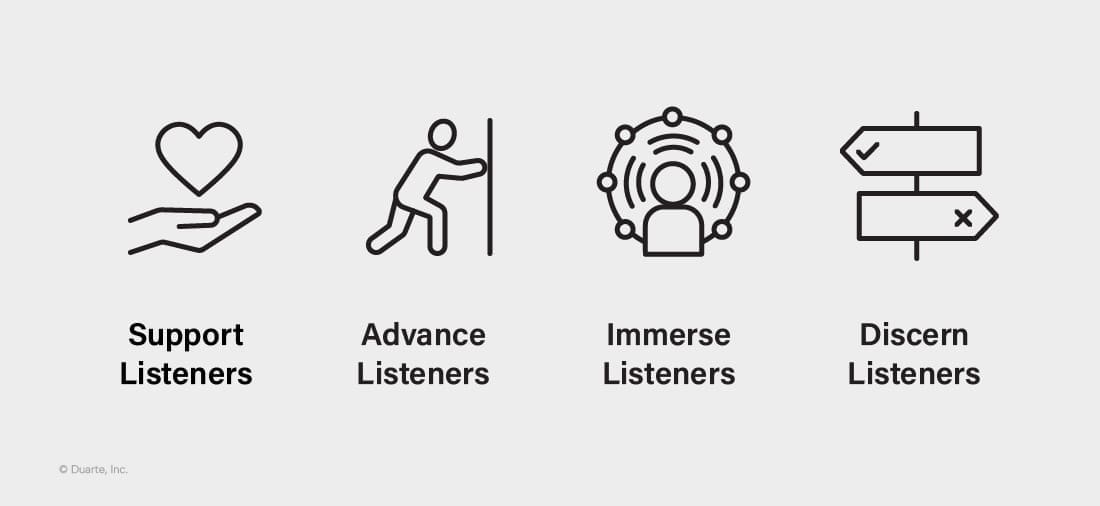
You’re either one or more of these styles by default. While you may not use your listening style in every interaction, you do tend to gravitate toward it. It’s possible you’ve never thought about it or even noticed it because it’s habitual. You’ve listened the same way for years, perhaps since childhood, and you’ve stuck with those listening skills simply because they’re ingrained in your muscle memory.
Now, each one of these S.A.I.D. Listening Styles™ brings value to an organization. In fact, we need all of these types of listeners, regardless of industry. But we get into trouble when we default to our style without considering what the person speaking needs in that interaction.
Adaptive Listening™ asks listeners to avoid using their S.A.I.D. Listening Style™ simply because that’s what they’re used to, and instead, ask themselves, “What does the person speaking need from me right now?” The methodology teaches listeners when and how to lean on their listening style and when to adapt to a different one based on the speaker’s goals.
The first step in becoming an Adaptive Listener™ is to uncover your S.A.I.D. Listening Style™. While your style can and should be used some of the time, if your style doesn’t match the goals of the person speaking, it could be a barrier to effective listening. See if you can determine what your S.A.I.D. Listening Style™ might be based on the descriptions below.
If you tend to focus on the speaker’s emotions while you listen, you might be a Support Listener. People come to you with good news to celebrate or a hard day to vent about, because you make them feel heard. It’s a real gift on any team, and it can become a barrier when the person needs something other than validation in the moment. For the full S.A.I.D. model, see Effective Listening Skills.
If you have a habit of focusing on moving things forward while you listen, you might be an Advance Listener. People often go to Advance Listeners when they need to drive people, projects, or processes to the next steps. During a meeting or brainstorm, Advance Listeners tend to generate ideas quickly and might speak up more often because they want results and they want them to happen quickly.
Advance Listeners also tend to link ideas across contexts. As soon as they recognize that an idea or an action works in one situation, they start thinking about ways those same ideas or actions can be applied elsewhere.
Advance Listeners are a great asset to teams and organizations. After all, they’re the listeners who help get things done! But these characteristics could be a barrier to effective listening if the person speaking isn’t looking for action or forward momentum in that moment. The most effective listeners adapt to listen the way the speaker needs.
If you have a habit of focusing on the content while you listen, you might be an Immerse Listener. People go to Immerse Listeners if they missed a meeting, because Immerse Listeners tend to catalog all the details. They either soak up the information mentally or they write it all down to ensure they’ll remember.
Because Immerse Listeners are so focused on remembering the content, they also like to gain confirmation on what was said. They might summarize or paraphrase the speaker’s message to make sure they heard the information in the exact way the speaker intended.
Like Support and Advance Listeners, Immerse Listeners are also a huge asset to teams and organizations. Their focus on the speaker’s content ensures they, and everyone around them, understands, retains, and recalls the information. Of course, these characteristics could be a barrier to effective listening if the speaker needs more than that. Sometimes listening to understand and remember isn’t enough in the workplace.
If you have a habit of evaluating the information you’re hearing, you might be a Discern Listener. People go to Discern Listeners when they need someone to offer critical and candid feedback. That’s because Discern Listeners naturally embrace criteria. Instead of listening without preconceptions, they compare the new information against existing norms (or they’ll suggest criteria where none exist). Then, the Discern Listener uses these criteria to judge the information they’re hearing.
Discern Listeners also consider alternative ideas. They might offer opinions that others don’t think of or aren’t brave enough to verbalize, sometimes because they’re looking to avoid future risk.
There is a time and a place for evaluating information at work, and that’s when Discern Listeners are most valuable to teams and organizations. But like the other S.A.I.D. Listening Styles, these characteristics could be barriers to effective listening if the person speaking isn’t looking for their content to be evaluated.
Ever walked out of a conversation and realized you barely remember what the other person said? Maybe you were half-drafting your reply, the room was loud, or you just weren’t in the headspace for it. It happens to all of us. When listening goes sideways, it usually traces back to one of four places, and we use the Listening LENS to find it. LENS stands for Listener, Environment, News, and Speaker.
Once you run through the LENS, you can usually spot what’s getting in the way and adjust while it still matters.
Perhaps after reading about the characteristics of each S.A.I.D. Listening Style™, you’re fairly confident you recognize yours. If you’re not sure, we created a listening book for that!
Duarte video: Listening skills you didn’t know you needed
Adaptive Listening™ goes into much more detail about each of the four listening styles. While they all have characteristics that bring value, they also have cautions. And even if the person speaking needs your listening style to meet their goal, that doesn’t necessarily mean you know the right way to process and respond while using your style. The fact is, we can all work on being more effective listeners, even in situations where our listening style is needed.
Uncovering your S.A.I.D. Listening Style is a great first step in preventing barriers to effective listening. But once you know your listening baseline, the best way to become an effective listener is to adapt your listening to meet the goals of the person speaking to you.
Not sure what the person speaking to you needs? Here’s the good news: The Adaptive Listening™ methodology says speakers have only four goals in the workplace, not an infinite amount. Speakers want listeners to:
Yep, these match the S.A.I.D. Listening Styles. That’s why we named them the S.A.I.D. Listening Goals™! So chances are, you’re already quite good at listening in one of these ways. Adaptive Listening: How to Cultivate Trust and Traction at Work will take you even further on your journey to becoming an effective listener. Grab your copy today to learn more.
What are the biggest barriers to effective listening?
The biggest barriers to effective listening are usually your own habits. Most of us lean on one listening style, Support, Advance, Immerse, or Discern, and use it even when the speaker needs something else. Other barriers come from the conversation itself, which the Listening LENS sorts into four sources: the Listener, the Environment, the News, and the Speaker.
What is a listening LENS?
The Listening LENS is a quick way to spot where listening breaks down. It stands for Listener, Environment, News, and Speaker, the four places a barrier can come from in any conversation. Running through each one helps you notice what’s getting in the way before you respond.
How do you overcome barriers to effective listening?
Start by uncovering your default S.A.I.D. Listening Style so you know your baseline. Then run through the LENS to catch what’s interfering. From there, adapt your listening to the speaker’s goal instead of your habit. That shift, from your style to their need, is the heart of Adaptive Listening.