Change Communication Training
Drive strategic change
Craft an effective communication strategy that sparks and sustains change with empathetic speeches, stories, ceremonies, and symbols that motivate and inspire teams.

Change puts leaders and workers in a delicate dance, and nowhere is this more apparent than efforts around AI adoption. Even those with a cursory knowledge of the industry know the score. Opinions swing from feverish support to a spectrum of aversions, with some ambivalence sprinkled in.
Ask 10 people at random in your organization to be candid about AI and a range of answers could bubble up. Where some will start jabbering about The Terminator or losing truth like tears in rain, others can’t wait for the “super intelligence” to cure cancer, solve climate change, and set humanity free. Some would rather talk about the weather.
For organizations who struggled through previous tech revolutions, FOMO (fear of missing out) is a ticking clock. The risk of not adapting could be detrimental. But when AI-enablement becomes an end in itself, organizations likely aren’t asking the right questions. Do we need this AI tool? What’s lost by automating this workflow? Should this agent really get a company credit card? With wildly divergent takes percolating through the ranks, achieving AI adoption at scale needs an era-defining story.
It’s why Fortune 50 companies and global brands continue to rely on core communication skills for sparking and sustaining change. Leaders need the ability to acknowledge difficulties, challenge pushback, and build momentum behind their vision. This demands a winning trifecta of time-tested storytelling structures, design principles, and presentation strategies to help everyone feel invested in the same outcome.
Unfortunately for the tech maximalists, these deeply human qualities can’t be automated. AI can’t get on stage, capture the moment with a story, or move a reluctant audience to action. Prompt engineering and vibe-coding can only get you so far in your quest for change.
But here’s the bright side. Duarte’s Illuminate™ change communication methodology is a proven framework for moving organizations from an engrained way of doing things and into a new bliss of transformation. In the age of AI, three-act narratives, ceremonies, symbols, speeches, and crisp, clear visuals remain essential ingredients for inspiring lasting change.
Like most visions, it all starts with a dream. But first, it helps to acknowledge reality.
Discussions around AI are scattered. Executives, managers, teams, and consumers all see different hopes and fears on the horizon. Polls of the electorate, major studies from universities, and corporate-backed surveys can all boost your overall AI understanding. But for leaders, knowing how workers feel about AI is essential to gauge the right approach for communicating your AI vision. Let’s zero in on the data that directly reflects your target audience.
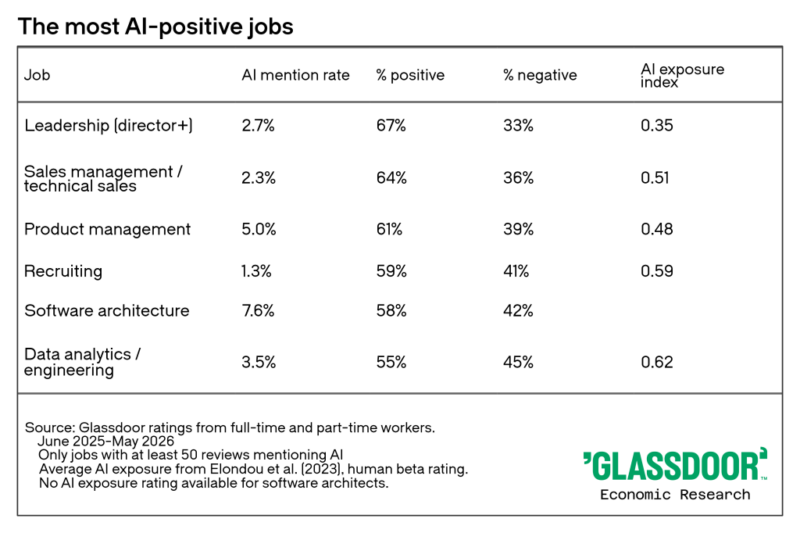
An August 2026 study by Glassdoor looked at employer reviews by workers and uncovered a range of opinions across rolls, demographics, and industries. Major trends spike for and against AI usage. Here’s a look at some of the more favorable results:
On the flipside, roles that value specificity around word-choice, flawless number-crunching, or rely on interpersonal relationships struggle to articulate value and skew negative:
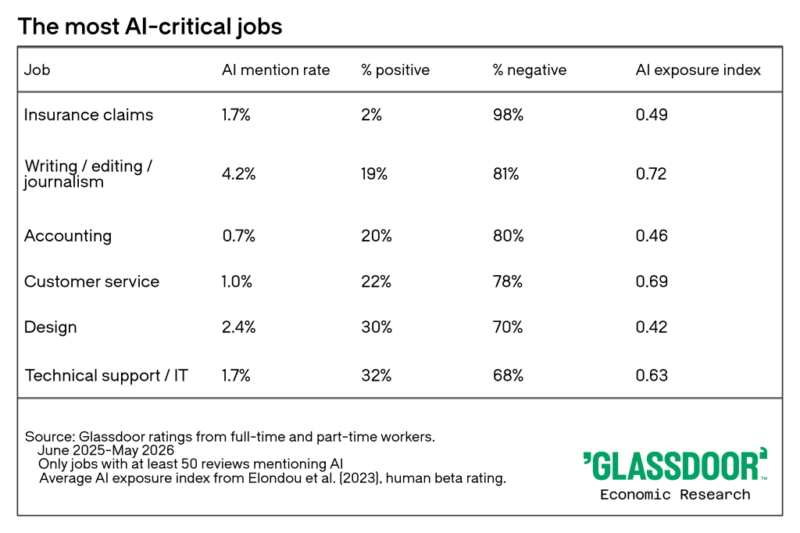
The data shows a divide in how leadership and key cross-sections of the workforce view AI. But the problem doesn’t stop with perception. A study from the University of Konstanz illustrates how employers are also sowing misalignment with the tools they prescribe. Here’s what they found:
“In many organizations, the major AI revolution has not unfolded as a planned transformation process so far,” explains Florian Kunze, head of the study and professor of organizational behavior at the University of Konstanz. “Instead, many employees are experimenting with AI, while employers are still lagging behind when it comes to establishing clear policies, providing training and implementing secure AI solutions.”
In a scramble to navigate AI’s novel problems and opportunities, leaders forget to define success. A recent Gallup poll revealed that, “only 25% of workers say their company has communicated a clear plan for AI integration.” This means the majority of businesses are offering inadequate guidance, confusing mandates, or no support whatsoever behind their AI initiatives. Unfocused usage can result in skills atrophy, sloppy brand assets, and runaway token spend.
In a rush toward progress, leaders unintentionally send mixed messages or miss speaking to the AI-averse or -agnostic workers within their organizations. Without a message that scales, AI strategy will never achieve comprehensive buy-in. Leaders need to anticipate pushback, take feedback seriously, and show their thinking to articulate a coherent, achievable path forward. Because if the vision is incomplete, incoherent, or inauthentic to organizational values, progress hits a standstill. Roadmaps veer off course. And top talent becomes disillusioned.
Thankfully, there’s a better way.
Committing to a proven change communication strategy can give your AI initiative the support it needs to take root and start delivering measurable ROI. Duarte’s Illuminate™ methodology is a trusted blueprint for change communication that can help motivate your teams to move boldly into the AI era. With dedication, grit, and grace, this proven 5-part process can serve as the pathway to success for your org’s AI adoption journey. And now, back to dreams.
Stage one of Duarte’s Illuminate™ framework aims to turn a moment of inspiration into a jumping-off point for change. Trailblazing leaders, or torchbearers, shed light on a possible future and ask their organizations, industries, and even humanity at large to picture it with them. To spark change, leaders in the Dream stage contrast what is with what could be to get audiences to acknowledge and crave a new bliss. This can be a better way of working, a new product, or an improved mindset toward a revolutionary idea like AI. These juxtapositions help leaders build tension and convince audience members to support their vision.
The Dream stage can include vision speeches or persuasive communication to establish the stakes and rally teams around the possibilities. But crafting content that moves audiences forward requires knowledge of their hopes and fears around the topic you’re addressing. Leaders should test the waters around their vision before making any official announcements and listen carefully to what their teams are thinking and feeling.
According to Glassdoor, AI resistance breaks into eight buckets from concerns about the technology killing jobs (20% of negative replies) to AI distracting from the core business (13%) to companies using AI in alienating ways like workplace surveillance or as a stand-in for executive comms (10%). With these reactions on the rise, leaders need a vision for AI adoption that goes beyond just use it, OK?
Try this instead:
What Is: Teams are tired of manually tracking data updates, brainstorming content, and conducting buyer research in a decaying search environment. AI has its drawbacks, but competitors that embrace and clearly define adoption are going faster and farther with AI-enabled workflows.
What Could Be: With proper AI SOPs, IT-supported integration, and temperature checks along the way, teams can cut extraneous steps from ingrained processes, boost systems maintenance, and deliver quality results that keep pace with the competition.
The New Bliss: Now AI-enabled, teams can further refine their workflows, enjoy freer schedules to establish deeper customer connections, contact additional accounts, and explore creative projects with newly available bandwidth.
For the best results during the Dream stage, approach the process with clear-eyed reflection around:
With the right framing and justification backing up your new bliss, it’s time to take the Leap toward change.
Organizations enter the Leap stage when torchbearers successfully convince their teams to commit to action. Leadership is seeing their AI message amplified across teams with action-oriented words and phrases that denote consensus. AI processes are rolling out. All-teams meetings and syncs become part of the adventure. At this stage, maintaining a steady pace and celebrating progress are essential to keeping FUD (fear, uncertainty, and doubt) in check.

Leaders can reinforce a sense of wonder with speeches that give more context to vision or remind teams of what’s at stake. Since AI adoption requires buy-in and participation from everyone, consider structing your AI strategy as an incubator rather than a top-down solution. In a period of discovery, workers should feel empowered to share their AI approach and contribute to the company’s evolution. Telling the right story from the jump can help lock-in commitment.
Duarte’s own path included a summer vibe-coding experiment that prioritized time for exploration. Weekly AI Office Hours nurtured curiosity by creating space to share knowledge, pool strategies to cut token spend, and produce clearer outputs. Teams united to maintain a prompt library, update brand guidelines, and test guardrails. And with AI as a thought-partner, teams were encouraged to bounce and pressure-test ideas throughout their workflows.
Giving your tech stack an AI makeover isn’t as flashy as a new product or HQ. But with the right support and ongoing commitment, organizations can position themselves to harness emerging tools and stay nimble in fast-moving environments. And that means bracing for known and unknown challenges.
During any quest toward change it’s inevitable that something goes wrong. With AI, there’s a myriad of potential problems. Inadequate prompts that produce unusable output. Accuracy issues and hallucinations. “AI-Optimized” workflows that take longer than before. Or the never-ending march of news stories for and against adoption. Rather than glossing over hardship or squashing dissent, leaders seeking AI adoption should treat resistance or exasperation as an opportunity to check in with teams and modify their change plan.
In a C200 column for Forbes, Duarte CEO, Nancy Duarte, reflected on her experience announcing a bold AI vision at Duarte’s company kickoff. In the intervening months, eureka moments and patches of rough air crystalized a new vision for change in Nancy’s mind. To successfully launch and implement a new vision, leaders must embody three critical personas to spark and sustain change at their organizations: the Seer, the Orienteer, and the Storyteller.
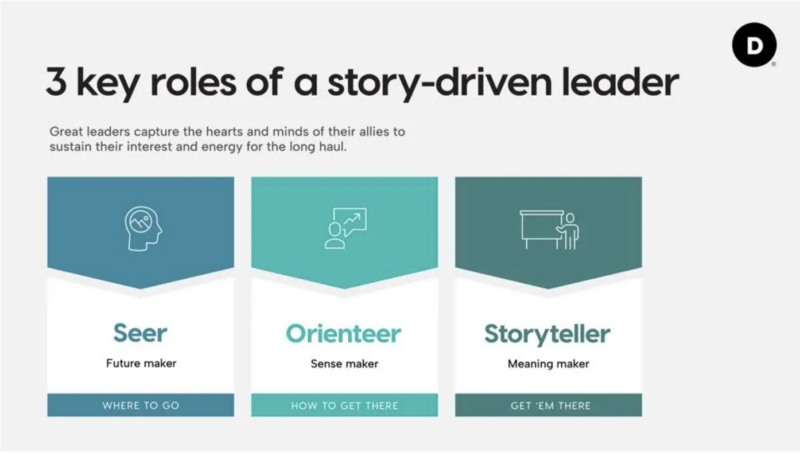
Every fight will demand leaders revisit one or more of these personas. When the destination gets fuzzy, Seers help bring it back into focus. If a pathway stalls out, Orienteers chart a new course. When competitors leapfrog your team’s AI outputs, Storytellers makes meaning of the struggle. Once in flight, successful change requires regular, transparent communication to support alignment and nourish teams with up-to-date information.
Viewing change from the vantage point of each persona helps weave a continuous thread through your transformation. It situates hurdles and punctuates skirmishes to note victories and lessons learned. In the Fight stage, leaders need to constantly reevaluate whether the most prudent path through a rough patch is perseverance or a pivot. Here’s where regular, open contact with teams (like AI Office hours for instance) or battle speeches at key turning points are critical for morale.
Unacknowledged problems, progress delays, and lack of guidance are natural sources of FUD. Keeping the right narrative afloat can help teams stay on track for the long haul. Because if you thought the fights were bruising, get ready for the climb.
Initiatives lose steam. Deadlines come and go. Surefire fixes prove insufficient. Transformation’s messy middle can monkey wrench even the best laid plans and overwhelm organizations of all sizes. When your teams start to question their ability to carry on, congratulations, you’ve made it to the Climb stage.
But here’s the thing: you’re still in the Fight stage too. These happen concurrently and test leaders to pull the right lever. The Climb stage contrasts the seemingly endless plodding between sites of conflict and aims to mark the progress. It’s the most trying stage for teams and leaders: uphill without the adrenaline.
Where AI feels infinite, humans are not. They get exhausted, burnt-out, and discouraged. During the Climb stage, workloads compete against AI obstacles, AI-generated results prove lackluster, and new workflows create new problems. Adoption slows. Teams backslide into old habits, as competitors seem to charge full speed ahead. Now you’re even starting to wonder: Will we ever reach AI adoption?
Balancing the right approach requires a holistic understanding of the situation. Open lines of communication through 1:1s with team leaders, anonymous surveys, and live Q&As can help gather necessary context and measure the scope of the problem. Where Fight messaging aims to ready teams for battle, the Climb is about letting past accomplishments refuel your change efforts.
“Keep reminding people how far they’ve come and why the destination is still worth reaching.”
Each temperature check is an opportunity to revitalize the message, water hard workers staying the course, and gain insight into what’s tanking your vision. Help stragglers realize they’re not alone, that transformation doesn’t happen overnight, and the investment of time, energy, and resources is paying off.
As leaders, if you’re having a difficult time defending your decisions for change, you could be falling victim to the sunk cost fallacy. A bitter pill to swallow. And that’s why having 360-coverage of your organization is paramount to success with widescale change efforts. That way, it’s easier to diagnose problems, know when to abandon a change effort, and when it’s finally paying off.
At long last, the balance between dreaming, delegating, and doing is in perfect harmony. Leaders divined and painted an image of the future, and workers mobilized to get it done. After all the leaping, fighting, and climbing, your new bliss becomes reality. Teams are AI-optimized, workflows are agentic, and outputs are humming along at a greater clip. Dissenters and critics will always have their private grumbles, but your message prevailed. Mission accomplished, right?

Yes and no. Unlike taking a product to market or migrating to a new CRM, being AI-enabled means staying current with innovations and best practices. Just how cybersecurity demands regular re-education and updated procedure, AI requires an ongoing commitment. New models and capabilities are constantly available, while vulnerabilities and exploits are keeping organizations on their toes.
Don’t let this dampen feelings of accomplishment. Retooling how teams engage with their work, adopting new SOPs, defining and then achieving success are all causes for celebration. Where some organizations might be party-averse, teams need time to reflect on and process the journey. Schedule an open mic or fireside chat where folks can share their experience and take part in the mythmaking that enriches workplace culture.
After s’mores (or something stronger) at the closing ceremony, it’s time to settle in and sustain the change. Workers can refine their AI agility, and leaders can get back to pulling their next change initiative from the clouds.
Organizations once had longer runways for reinvention. Now industry evolution can happen overnight. This shock and awe of accelerated uncertainty calls for prompter action. Geopolitical friction, supply chain snafus, and technological disruption are baked into daily life. Companies need to stay nimble and endlessly recalibrate to each new normal. With everyone tugged in different directions, team alignment requires a message crafted, delivered, and supported to withstand the headwinds of constant flux.
Whether your organization is taking a proactive posture on an emerging opportunity like AI or repositioning to batten down the hatches, committing to a proven framework for change communication can help ease the transition.
If change has your org feeling adrift, reach out with your most pressing communication problem and a Duarte Concierge can point you toward the right solution. Our strategists, designers, speaker coaches, and training facilitators are standing by to lend clarity, composure, and conviction to your change initiative.
Rally your teams with a story they can’t help but tell and put the future in perspective.