
Adaptive Listening®
Build trust and traction
Uncover a better way to listen that goes beyond active listening and paying attention. Learn about the way you prefer to listen, and adapt to meet the needs of others.

Getting a budget approved lays the groundwork for what’s possible. It’s the first step in product innovation, bringing new offerings to market, building out internal systems of support, and telling your organization’s story on the world stage. This flurry of outcomes stems from making a case for why decision-makers should fund your idea. When given a green light, you’re ready to sow plans and trellis them into reality. But not everyone can look at a patch of dirt and see a garden.
Budget-approvers aren’t thinking about the future in abstract terms. Their world boils down to numbers. As the ones ultimately accountable for the success or failure of a project, the pressure is immense to make the right choice. The health of the company and fiduciary responsibility are twin anchors that keep their focus on the bottom line. The result is budget conversations that fixate on the dollar amount.
As budget seekers, it’s your job to help decision-makers see the full picture, something no dashboard or spreadsheet can relay. Not that balancing expenses can’t be thrilling; the numbers need to be addressed and add up if you hope to move forward. But you also need a story that pulls leaders away from project allocations and fiscal calendars to truly grasp what their approval could mean in full technicolor, like Dorothy stepping into Oz.
Painting the right picture of the road ahead secures time, resources, and organizational backing: the main ingredients of any successful project. To help gain traction and earn funding for your next endeavor, here’s 3 narrative techniques you can use to help bring your project to life.
It’s not enough to make the money disappear. Leaders need to have it reappear in the form of ROI. While it’s impossible to predict the future, the story you tell about your vision helps budget-approvers align their expectations. Just how producers review scripts and storyboards ahead of bankrolling a film, decision-makers need help envisioning the final cut.
Before Christopher Nolan reimagined the The Odyssey with a $250 million budget, he adapted Christopher Priest’s novel The Prestige for a meager $40 million. Set in Victorian London, the 2006 film depicts a rivalry between two magicians and opens with a voiceover by Michael Caine describing the three parts of a magic trick. It goes something like this:
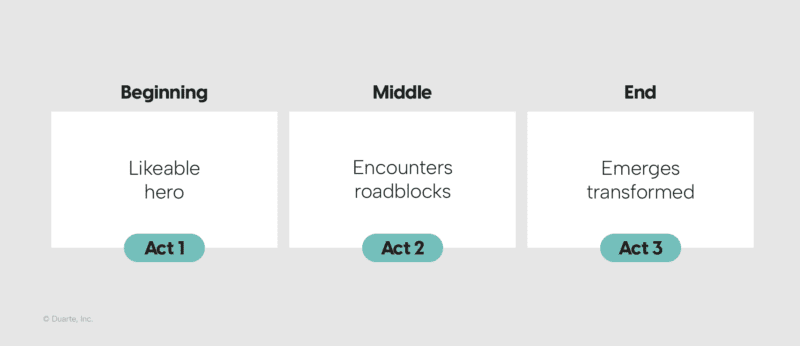
The pledge, turn, and prestige of your budget proposal should convey spectacle while still speaking to the hopes and fears of the budget-approvers. At Duarte, we encourage a 3-act structure of beginning, middle, and end when telling any story: from making well-researched recommendations to moving audiences to embracing your ideas.
To highlight the effect, here’s description of the project that’s light on story:
“With a $40 million budget, the film could gross upwards of $100 million at the box office, achieve a runtime of 130 minutes, and ultimately aggregate a 76% on Rotten Tomatoes based on 208 reviews.”
Precise, data-backed, and utterly devoid of life.
Let’s try that again with a 3-Act Structure:
“With your help approving our $40 million budget, this film will be a stunning reimagining of Christopher Priest’s award-winning novel and feature performances by Hugh Jackman, Christian Bale, Scarlet Johannssen, Michael Caine, and David Bowie in his most true-to-self role since Labyrinth. The adaptation will take painstaking detail, but the cross-over appeal into fantasy and science fiction genres will attract diverse audiences along with the cast’s combined star-power. With the caliber of craft and talent behind this project, we believe it has the potential to delight and puzzle generations of viewers, earn critical accolades, and see over 200% ROI at the box office and beyond.”
See the difference?
The second example makes the budget-approver the hero as the one putting the process in motion, acknowledges the struggle, and transforms the dollar amount into a fully formed vision of the finished product. Where example one is hyper-focused on ROI in terms of metrics, example two clearly combines projected ROI with loftier dimensions like legacy and cultural capital to elevate the pitch. It’s the difference between telling a story in the form of a chart and one meant for the silver screen.
The real trick, of course, is convincing budget-approvers that you can make it happen. And that’s where it helps to sprinkle in a little magic.
When it comes to telling your budget story, you need the confidence of a career slugger. This doesn’t mean making bold claims and hammering out the details later. No one needs another Fyre Fest debaucle. Honest, reflective budget-seekers already know what they’re capable of and how they rise to meet challenges. It’s the budget-approvers who need to be convinced. Before you can reach your goals, you need to wow decision-makers into believing you will. You need swagger and the skills to back it up. Babe Ruth’s infamous called shot provides the perfect example.
In Game 3 of the 1932 World Series, the New York Yankees were playing the Chicago Cubs at Wrigley Field. Animosity was roiling between the two teams, and the crowd was veering hostile as Babe Ruth stepped up to bat in the 5th inning. After taking two strikes from Cubs pitcher Charlie Root, Ruth made a pointing gesture to the stands. On the next pitch, Ruth hit a homerun, and the Yankees went on to sweep the series.
The 1932 world series may have faded from memory without the legend Ruth created at the plate. Despite eyewitness accounts, books, and grainy footage continuing to litigate the true events of the day, a headline from reporter Joe Williams had already captured the popular imagination:
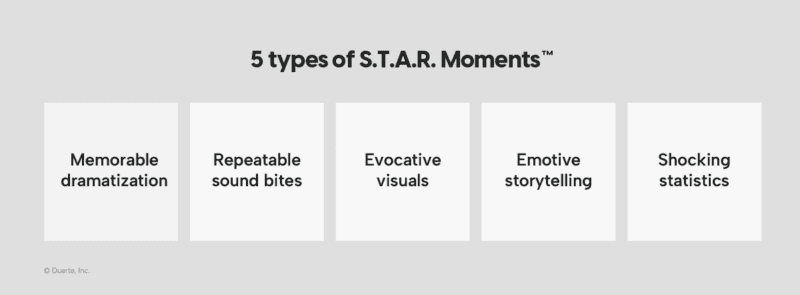
At Duarte, we call seizing opportunities to stand out S.T.A.R. moments, short for Something They’ll Always Remember. Deployed to great effect during Academy award-winning documentaries and keynote presentations, creating a S.T.A.R. moment can also win over budget-approvers to fund your project into fruition. Before your next budget talk, ask yourself: how do I convince budget-approvers my next swing will be a homerun?
While a certain amount of braggadocio can have its place, confidence built on deep thinking, practice, and preparation is more durable when the heat is on. Ruth was batting a .341 in 1932 and had already racked up 41 home runs when he raised his hand in the 5th inning. As a budget-seeker, you have one chance to demonstrate competence, build trust, and earn credibility when it’s time to swing.
Spend too long explaining your sound industry analysis or describing your accomplishments and budget-approvers might hit the showers. Instead, create your S.T.A.R. Moment by presenting your budget proposal with multimedia elements that help you deliver a crisp, clear budget story that makes the approver the hero. Before entering the room or clicking that video call, ask yourself which phrase best describes your budget story:
Here’s what I can do
or
With your help, here’s what we can do
By centering the approver in your S.T.A.R. moment, you’re nudging them to participate in your project as more than a line item. From there, telling a story that lands on an emotional level can drive decision-makers to connect passionately with your potential and root for your success.
Short of transfixing approvers with magic and mystique, crafting your message with empathy and emotional heft can do the heavy lifting of forming a deep connection. Infusing stories and situations with complex feelings requires channeling human elements that transcend details and plot. It’s what helps audiences see something larger in cultural events like films and sporting events and explains why people sometimes cry while watching commercials.
One way to reach emotional and analytical audiences is to balance the financial aspects of your budget ask with the new bliss of its potential. At Duarte, the new bliss is what audiences stand to gain after the messy middle of working toward a goal or implementing a change at their organization. As budget-seekers, illustrating the tension between what is and what could be can guide approvers to crave the new bliss outlined in your budget proposal.
Incorporating structure and story can help your budget proposal speak to the financial realities while encouraging decision-makers to envision a new bliss. Perhaps your CFO wants reassurances on spend, but also regularly misses their child’s ballet recitals. Maybe leadership is anxious about the company’s status in the industry. Or they want to create a product, service, or solution that’s profitable and actually helps people.
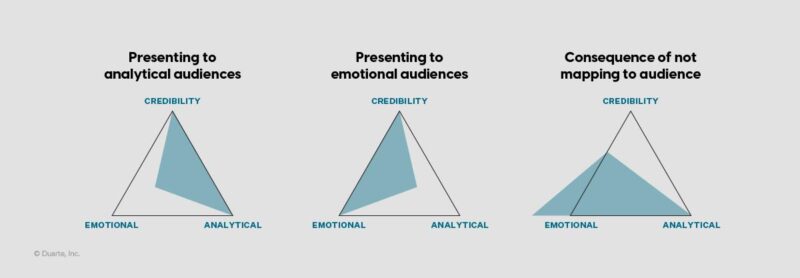
Centering your proposal on how your project will make a boatload of money is certainly one approach. But what about a budget story that highlights how your vision for a more efficient workflow can give everyone (and specifically your CFO) more family time? Or how your innovation could reinvigorate public interest in your brand? Or how, with proper funding, you aim to remove a clear pain point from the customer experience? This difference can help stakeholders feel a personal commitment to the project beyond just giving their approval.
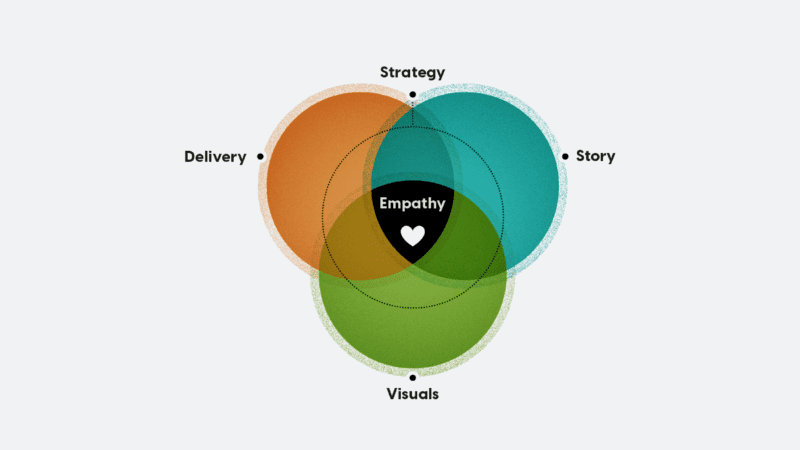
Calibrating the perfect balance means rooting your story in audience-first empathy. By acknowledging the inner lives of your budget approvers, you can structure your story to include sound financial reasoning with details that register on an emotional level. After time and money, organizational backing is the greatest indicator of a project’s success. Securing it at scale requires turning buy-in into belief with a story that reverberates at every level. But get too sentimental, and you risk losing sight of the stakes.
Deliver a budget story that’s structured, empathetic, and boosted by a well-placed S.T.A.R. moment, and you’re rubberstamp-ready to pave the road ahead.